Poly-Synth
Taped out on Tiny Tapeout SKY26c, silicon pending
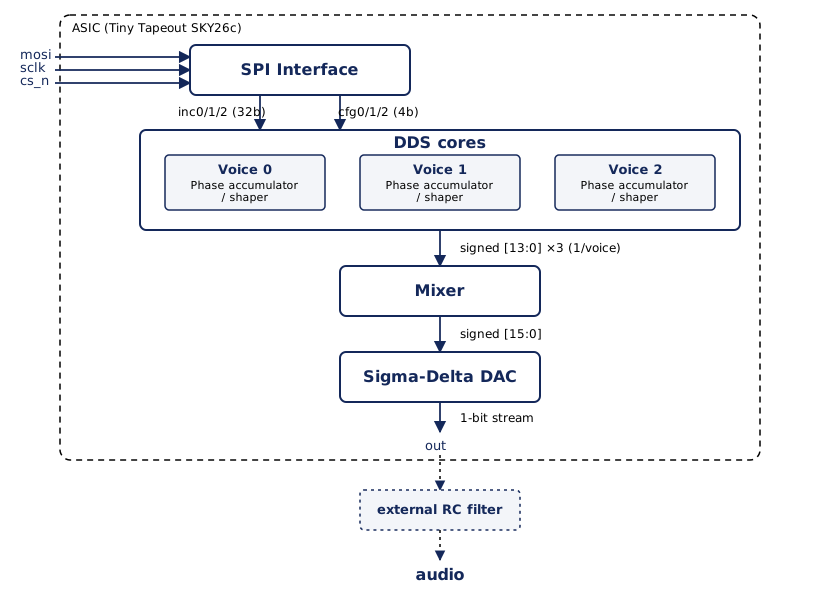
Poly-Synth is a 3-voice polyphonic synthesizer ASIC, taped out on Tiny Tapeout SKY26c. It takes an input as a tuning word over SPI, passes it through one of 3 DDS cores, which consist of a phase accumulator and a shaper. Finally, the 3 voices are mixed arithmetically and are output via oversampling with a 1st-order Sigma-Delta module.
Hear it
These two clips were recorded from the FPGA prototype of Poly-Synth. A Python program decodes MIDI songs into the tuning words each note needs, then bit-bangs them to a microcontroller that drives the synth.
“Overworld” from The Legend of Zelda
An arrangement of the theme composed by Koji Kondo.
“Vampire Killer” from Castlevania
An arrangement of the theme composed by Kinuyo Yamashita and Satoe Terashima for the original game.
System
Verification
Each module was built against a golden-model testbench, and I mutation tested those testbenches to make sure they actually catch bugs. The top-level testbench runs against both the RTL and the post-layout gate-level netlist. Finally, the design ran on an iCEBreaker FPGA, playing MIDI songs straight into a pair of headphones with no amplifier.
How I used AI
Before this project, I knew digital logic, but I had never heard of RTL, HDLs, or Verilog. AI was by far the fastest way to learn. It taught me the basics of the language, helped me work out the architecture, and helped me debug. Every line of the RTL was written by me. As I get better, I plan to lean on it less, especially for architecture.
Status and next steps
Poly-Synth is taped out on Tiny Tapeout SKY26c, and silicon is pending. Once the chips arrive, I’ll bring the design up on the Tiny Tapeout demo board, driving it over SPI from the board’s RP2350 and listening through the RC filter described in the datasheet.
The design has no envelope (ADSR) or other audio shaping yet, so every note starts and stops abruptly. Adding that is the plan for v2.0.